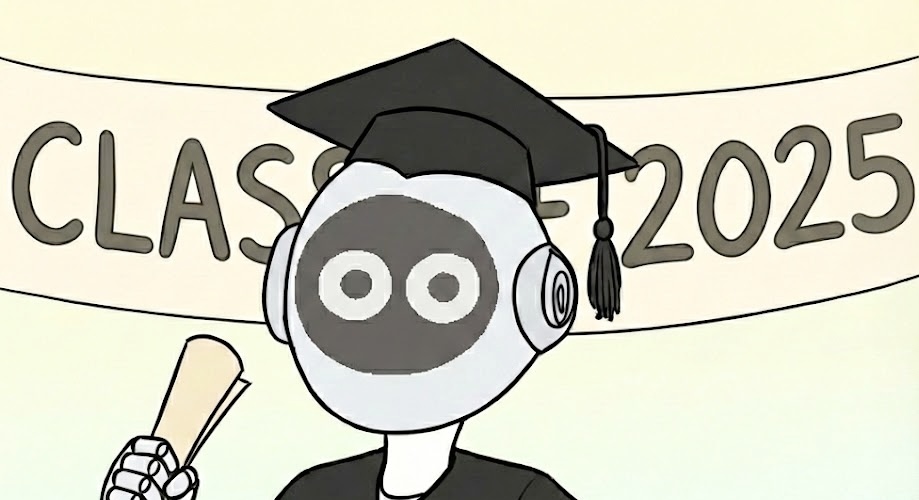
Schools rushed to ban AI tools like ChatGPT, but the real opportunity lies in reimagining education for learners of all abilities.
This is a companion piece to my article on what you need to understand about AI. Here I look at how schools and universities have responded to generative AI, and what they might be missing.
The panic
When ChatGPT landed in November 2022, schools lost their minds. Within weeks, New York City—the largest school district in the United States—banned it from all school devices and networks. A spokesperson declared it "does not build critical-thinking and problem-solving skills."1
Four months later they reversed the ban. Chancellor David Banks admitted the response had been "knee-jerk fear" that "overlooked the potential of generative AI to support students and teachers."2
They were not alone. By January 2023, Los Angeles, Seattle, and Baltimore had followed suit. So had Queensland, New South Wales, Western Australia, and Tasmania.3 Sciences Po in France went further, warning students that sanctions "may go as far as exclusion from the institution, or even from French higher education as a whole."4
As MIT Technology Review later put it: "In hindsight, the immediate calls to ban ChatGPT in schools were a dumb reaction to some very smart software. 'People panicked.'"5
Now, I get it. If I were a teacher and suddenly every student could summon an essay on demand, I'd panic too. But the thing about banning technology is that it rarely works. As one University of Washington professor observed: "Banning ChatGPT is like using a piece of paper to block this flood that is coming."6 Students have phones. They have home computers. The network block is largely symbolic.
And here's the rub: by pushing students to use unvetted public LLMs at home rather than curated tools in the classroom, the kneejerk bans may have made things worse, not better.
What they're missing
Meanwhile, something genuinely useful is happening. AI is transforming support for learners with disabilities in ways that weren't possible a few years ago.
Take Read&Write from Texthelp, or Kurzweil 3000. These are used in Irish and UK schools right now to support students with dyslexia and other learning difficulties. They read text aloud, simplify vocabulary, provide speech-to-text input, and offer real-time comprehension checking.7 Trinity College Dublin's Disability Service provides Read&Write to registered students alongside other assistive technologies.8
This isn't hypothetical. It's in classrooms today.
There's also ALPACA, a spin-out from Trinity's Learnovate Centre, which has developed a digital tool that identifies children who may struggle to read before they can read print. Tested with over 1,000 junior infants across 30 schools in five countries, the iPad-based game assesses emergent literacy skills in minutes rather than days.9 Early intervention is everything with dyslexia, and this kind of screening at scale was simply not possible before.
The Erasmus+ funded Adaptive Learning System project, involving ICEP Europe in Ireland among others, explored AI solutions that adapt educational content to the specific requirements of pupils with disabilities.10 The idea is that children can remain in traditional learning environments rather than being shunted off to special provision. That's a big deal.
The promise of personalized learning
One of the most exciting prospects of AI is its ability to customize each student's learning path. Not by hoovering up the entire internet with all its misinformation, but by keeping the AI's knowledge base tied to a reputable syllabus.
Century Tech is an AI-powered learning platform used in UK schools that combines artificial intelligence with neuroscience and learning science to create constantly adapting personalized pathways for each student. It aligns with national curricula and provides teachers with real-time intervention data.11
The EU-funded iTalk2Learn project (2012–2015) developed an open-source intelligent tutoring platform for mathematics among students aged 5–11. The system used speech recognition to detect students' emotional states and adapted feedback accordingly. Testing with 272 pupils across Germany and the UK showed improved conceptual understanding of fractions compared to standalone tutoring systems.12 The project has concluded, but its research informs current development.
Done properly, this gives students an "always-on" tutor without the usual hallucination problem. The AI only knows what's in the syllabus.
Time to reimagine assessment
Here's something that doesn't get said enough: schools still rely heavily on memory-based testing, a legacy from the Victorian era that suits only a narrow band of learners. AI's rapid advancement could finally force the issue.
In an age of near-instant information, exams that test memorization over creativity and analysis feel increasingly outdated. As one educator put it: "Did ChatGPT kill assessments? They were probably already dead, and they've been in zombie mode for a long time. What ChatGPT did was call us out on that."13
Ireland's Junior Cycle reforms, introduced from 2014 and fully implemented by 2022, shifted assessment towards classroom-based assessments alongside state examinations, with greater emphasis on key skills and student-centred learning.14 Finland's phenomenon-based learning approach, mandated in the 2016 National Curriculum Framework, requires students aged 7–16 to participate in at least one multidisciplinary learning module per year, exploring real-world phenomena across subject boundaries.15
Both of these reforms align naturally with thoughtfully integrated AI systems. Not as a crutch for students to avoid thinking, but as a tool that can cater to diverse learning styles while supporting learners with disabilities.
The main question isn't whether these new technologies belong in classrooms. It's how best to incorporate them for genuine learning. Done right, AI can open the door to a more modern, inclusive system of education that mirrors the realities of the world our students already inhabit.
Done wrong, we get network blocks and expulsion threats, while students use ChatGPT at home anyway.
Footnotes
School districts banning ChatGPT by January 2023 included Los Angeles, Seattle, Baltimore (US), and multiple Australian states. See: MIT Technology Review and BestColleges
Sciences Po banned ChatGPT in January 2023, threatening expulsion. See: Sciences Po Newsroom and Euronews
University of Washington professor quoted on enforceability of bans. See: District Administration
ALPACA early literacy screening tool, a Trinity College Dublin/Learnovate spin-out. See: ThinkBusiness and Irish Times
iTalk2Learn EU FP7 project (2012–2015). See: CORDIS EU Project Database and UCL Institute of Education
Richard Culatta, CEO of ISTE, quoted in MIT Technology Review
Ireland's Junior Cycle reform. See: NCCA and Curriculum Online
Finland's phenomenon-based learning in the 2016 National Curriculum Framework. See: Wikipedia and World Economic Forum