Harder to Put Down
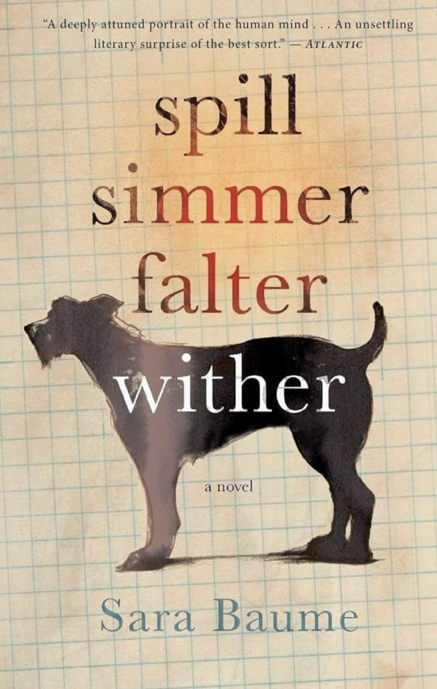
Spill Simmer Falter Wither
Author: Sara Baume
I find myself awake at night, and I have my own reasons. But some nights it is the world of Spill Simmer Falter Wither that's on my mind: I wonder did Ray make it through the night, or did One Eye bark the night away along with Ray's eight hours.
Not because it traumatized me, and not quite because it horrified me, though it has its horrors. It haunts in the way only literature can, because by the time the book shows you its darkest room, you understand the man standing in it. You may even see yourself in his shoes for a moment. And that is one for pause, or insomnia if you're me.
Months on, the plot has largely dissolved. What returns instead is a dishcloth hanging over a sink. An empty dog bowl. A draught through an old house.
That is Baume's particular gift. She animates spaces and ordinary objects until the physical world speaks as eloquently as her characters. Houses remember. Furniture carries history. Dust is never merely dust. The novel teaches you to look at the ordinary until it turns significant, and then, much later, it shows you why.
The Dog
One Eye is no sentimental literary dog. He is instinctive, unpredictable and genuinely dangerous, a one-eyed terrier bred to go down badger setts, rehomed to a man who saw his photograph in a shop window and recognized something.
Baume never judges. One Eye behaves according to instincts that make perfect sense to a dog, even as they appear alarming through human eyes. But she never lets you relax around him either. Every walk carries an undercurrent of dread. Another dog appears on the strand, a child appears behind the dog, and you're holding the page a little tighter: will he savage the child, or just the child's dog?
The menace never lives in dark alleys or strangers. It lives in the chores: a walk, a trip to the shop, a ring at the door.
The Man
Ray is fifty-seven years old and, in his own words, too old for starting over and too young for giving up. He has lived his whole life in his father's house in a small village, profoundly disconnected from the people around him.
You cannot help reaching for explanations. A damaging childhood? Abused? Neglected? Or simply unsupported. He reads to me like a man mildly on the spectrum whom nobody ever thought to make room for, and that neglect compounds with years. A man who might have developed into someone merely eccentric, had it not been for a father who loved and neglected him in infuriatingly contradictory ways, and a mother who is a loud absence in his childhood inventory. Baume permits every one of these readings and confirms none of them, and the novel is stronger for the refusal. The gulf that matters is not between Ray and a diagnosis or trauma or neglect. It is between the way he experiences the world and the way the world insists he move through it.
He is a man so unequipped for bureaucracy that a doorbell is an apocalypse. Officialdom, paperwork, the sequence of phone calls and appointments and strangers-in-the-house that ordinary life occasionally demands: these are not inconveniences, they are impossibilities. When a knock comes at the door, the reader feels it in the chest. The novel makes a doorbell one of the most frightening sounds in recent fiction, and it earns that honestly.
The Pair of Them
What develops between Ray and One Eye is not a rescue story, in either direction.
It is recognition. A man found wanting by human rules. A dog condemned by them, and only by them; no dog ever called another dog bad. Each is the only soul who would accept the other without first demanding he become something else.
The whole book is Ray talking to the dog. Second person, start to finish: you, your, yours. One creature speaking to another who cannot answer and will never ask him to explain himself. Once you notice it, it's heartbreaking.
The Road
And then, halfway through, it becomes a fugitive novel.
A bite, a knock at the door, and Ray does the only thing a man like Ray can do: he puts the dog in the car and drives. What follows is Bonnie and Clyde conducted at walking pace, two outlaws whose entire crime spree amounts to a dog bite and an unanswered doorbell, circling the coast in an old banger, sleeping in car parks, eating from petrol stations. But by then you are living in the car alongside them, and you cannot but know it for the last room of the house. The house that would not have them.
It should be absurd. It is absurd. It is also one of the most tender stretches of writing I've read in years, the four seasons of the title spilling and simmering and faltering past the windows.
Now. If any of this has caught you, go and read the book. Everything I've described lands harder on the page than it does in summary.
If you've not read the book, DO NOT READ THE SPOILERS BELOW. You are not ready. Go and get your hands on Spill Simmer Falter Wither; it's a short enough read.
And when you're back, or if you came here ready, dive in.
The attic. Of course it's the attic.
When Ray's father died, the necessary admin of death (doctor, ambulance, undertaker, funeral home) was not difficult for him. It was impossible.
Impossible in a specifically Irish way that readers elsewhere may not fully feel. Death in Ireland is not a private event. Within 24-48 hours comes "the removal", and with it the horde: sympathizers through the front door, handshakes in the hall, sorry for your trouble, tea to be made, the whole parish moving through the very rooms he had spent a lifetime keeping the world out of. There was nobody to stand between Ray and any of it. No mother, no sibling, no friend to make the calls and receive the mourners. If ordinary social interaction petrifies you, and you are the only living soul left to operate the machinery of an Irish death, the wake is not a comfort. It is a siege.
So he did the only thing a man like Ray could do: nothing. He put his father's corpse in the attic, and let the house hold what it held.
Here is where Baume's method reveals itself, because the mice were never atmosphere. All those casual observations scattered through the book, the smells One Eye keeps investigating, the small industrious sounds, the mice coming and going: the dog knew from day one. Baume gives the reader everything the dog perceives and trusts us not to assemble it until she is ready. The reveal adds no new information. It reinterprets everything already given. What read as texture was testimony. I went back to the early chapters afterwards; the same attentiveness that made the dishcloth tender makes the attic unbearable.
The mice are the undertakers Ray couldn't face. Piece by piece, over years, they perform the office he could not commission, until what remains is a tidy bag of bones and a skull, and a burial he can finally manage: private, wordless, witnessed only by the dog.
It should be grotesque. Summarized like this, it is grotesque. But by the time the novel tells you, you have spent two hundred pages inside Ray's way of being in the world, and what you feel is not revulsion. It is grief. An act of love by a man with no other ritual available to him. That is why the book haunts rather than horrifies: horror is what you feel about a stranger. What Baume leaves you with is compassion, and compassion is much harder to put down.
And still, when all of that has settled, there is something big left unsaid, something I cannot quite put my finger on. An absent mother, a father full of contradictions, a house full of rooms the book declines to open. Where is mam? Is she still in the house? That's the one that bounces round my skull at 3am.
I finished the book and caught myself looking differently at my own rooms, at their dishcloths and draughts, at the lives ordinary objects quietly preserve. What we leave behind is not kept only in photographs and stories.
Sometimes the house holds it for us, whether we'd like it to or not.